Hoisting my comment from over at Russ's place:
"But if we could overcome our childishness, profligacy, idiotic dogmas, petty and self-hobbling resentments, if we could assume adult responsibilities and become more rational and scientific (but also recognize the limits of reason and science), we’d transcend ourselves. If we, passionate beings, could live a fuller life of passion controlled and mediated by reason, passion sublimated as spirit and creativity, we’d transcend ourselves. This fuller, richer, more intelligent, more creative human being would be an “Overman” compared to the flawed, childish, dogmatic person of today, vacillating between hating his passions and being their slave; between the nihilistic worship of science and reason and the nihilistic rejection of them."
My fundamental (and growing) problem with Western philosophy generally is its insistence on describing how things are, which, once it is accepted as correct, becomes the description of how things ought to be. Because of the way the human brain works, merely substituting one description of how the world is with another will not, cannot, achieve the transcendence you seek. This is because the world is not a static thing. It is dynamic, never stuck in any one state.
The only way to break free of false dichotomies that our brains spawn whenever they accept an orthodoxy (i.e., anything that is not orthodox fails to meet expectations and, as a result, gives rise to a negative emotion that compels us to attack and change what disappointed us) is to stop trying to describe how things are and focus on describing how things work. We need to accept that human beings are NOT rational in the manner described (falsely) by Western philosophy, that human beings merely compare what they experience to what they expect and act emotionally on the basis of that comparison. Most philosophy/theology seeks to control human action by defining how the world is and, therefore, setting and controlling expectations of how the world ought to be.
The one exception I've found is the Tao Te Ching (I purposefully am not saying Taoism because I think the religion that has spun up around the Tao Te Ching is contrary to the Tao, which describes how the world works, not how it is or ought to be). I actually view the Tao Te Ching as just an ancient recognition of what I've discovered recently on my own.
The way for humanity to transcend itself is to embrace its humanity, and what defines humanity is the process of how we make decisions. We need to be realistic in what it means to be rational. We also need to be rational in what it means to be realistic. When we strike the proper balance between realism and rationalism, we will find a third way that transcends both.
Thursday, July 7, 2011
Wednesday, July 6, 2011
Placeholder: The Illusion (and Lie) of "Complexity"
I've said before that the world is no more complex today than it ever was, that human beings, through the division of labor, have become simpler and, therefore, less capable of understanding the world as it is (i.e., as it always has been and as it always will be). In this sense, complexity is an illusion.
I've recently come to the conclusion that complexity is not just an illusion, but a lie. Throughout the ages, the "complexity" of the current era has been pointed to as an excuse for maintaining the current power structure. Founders like Hamilton and Monroe relied on complexity, as did proto-neoliberal Walter Lippmann. Nieburh points to additional examples. The argument always goes something like this (although it is sometimes turned on its head): "the modern world is far too complex for any one man to fully understand, therefore, democracy is impossible and undesirable." Unspoken is the fact that all societies form so that both physical and intellectual labor can be divided among several people, which implicitly requires that no one person in society will ever know everything that is needed to run the society. "Efficiency" demands this.
The lie of complexity is often unwittingly employed by smart people like Charles Hugh Smith. Why? I believe it is because people like CHS are rationalists, that they honestly believe that human beings are "rational" in the manner economists and other social scientists (witch doctors) describe, and that the only way to describe "irrational" choices embraced by most people is by identifying a limit to rationality. But the commonly peddled definition of "rationality" is itself a lie, one that those in power ignore constantly. (And, not to mention, it is the alleged limits of human rationality the elite use to maintain their power.) At the end of the day, rationalists are the enablers of the power addicts (the hallmark of a co-dependent relationship).
The best way for me to demonstrate the lie of complexity is to use fractals. Fractals are often described as defining complexity or even chaos, but they are, in fact, the purest form of order: a pattern that iteratively repeats itself. As I've said before, I believe that humans behave fractally, that they apply the same basic decision-making function iteratively and at different levels of abstraction, thus explaining why markets appear fractal in nature. To understand (and even control) a society, all you need to do is understand the seed function employed by the mean of that society. Basically, all human action is determined by comparing what is experienced to what was expected and reacting to the emotion created by the mismatch, if any, between the two. The easiest way to control human action is to define expectations, as humans will work tirelessly (and violently, if necessary) to ensure that expectations are met. But propaganda is a useful tool for playing upon the cognitive biases of people to help them see perfect alignment (when expectations and experience are actually in conflict) and conflict (when expectations and experience are fully aligned).
The specific fractal I'm thinking of is called the Koch Star. As explained quite well by Wikipedia:
Let's visualize the explanation:
![]()
So, here's the lie of complexity. Mathematically,
The Koch Star is no different than our current reality. You can divide labor as much as you want, to infinity even, but that will not change the fact that we live in a finite world. The complexity of the modern world is just as illusory as the infinite length of the Koch curve. Yes, in theory, if you keep on dividing things in two forever, you theoretically create perpetual exponential growth, but reality quickly intrudes by placing real limits on what can be achieved. Anybody who attempts to sell complexity beyond the limits of reality is, by definition, a liar and a fraud. Even if they don't realize it.
A separate but related thought I will develop is that Taoism (as set forth in the original Tao Te Ching) is not a spiritual or religious tract at all, but a timeless description of the seed function of the human societal fractal.
I've recently come to the conclusion that complexity is not just an illusion, but a lie. Throughout the ages, the "complexity" of the current era has been pointed to as an excuse for maintaining the current power structure. Founders like Hamilton and Monroe relied on complexity, as did proto-neoliberal Walter Lippmann. Nieburh points to additional examples. The argument always goes something like this (although it is sometimes turned on its head): "the modern world is far too complex for any one man to fully understand, therefore, democracy is impossible and undesirable." Unspoken is the fact that all societies form so that both physical and intellectual labor can be divided among several people, which implicitly requires that no one person in society will ever know everything that is needed to run the society. "Efficiency" demands this.
The lie of complexity is often unwittingly employed by smart people like Charles Hugh Smith. Why? I believe it is because people like CHS are rationalists, that they honestly believe that human beings are "rational" in the manner economists and other social scientists (witch doctors) describe, and that the only way to describe "irrational" choices embraced by most people is by identifying a limit to rationality. But the commonly peddled definition of "rationality" is itself a lie, one that those in power ignore constantly. (And, not to mention, it is the alleged limits of human rationality the elite use to maintain their power.) At the end of the day, rationalists are the enablers of the power addicts (the hallmark of a co-dependent relationship).
The best way for me to demonstrate the lie of complexity is to use fractals. Fractals are often described as defining complexity or even chaos, but they are, in fact, the purest form of order: a pattern that iteratively repeats itself. As I've said before, I believe that humans behave fractally, that they apply the same basic decision-making function iteratively and at different levels of abstraction, thus explaining why markets appear fractal in nature. To understand (and even control) a society, all you need to do is understand the seed function employed by the mean of that society. Basically, all human action is determined by comparing what is experienced to what was expected and reacting to the emotion created by the mismatch, if any, between the two. The easiest way to control human action is to define expectations, as humans will work tirelessly (and violently, if necessary) to ensure that expectations are met. But propaganda is a useful tool for playing upon the cognitive biases of people to help them see perfect alignment (when expectations and experience are actually in conflict) and conflict (when expectations and experience are fully aligned).
The specific fractal I'm thinking of is called the Koch Star. As explained quite well by Wikipedia:
The Koch snowflake can be constructed by starting with an equilateral triangle, then recursively altering each line segment as follows:
1.divide the line segment into three segments of equal length.The Koch snowflake is the limit approached as the above steps are followed over and over again. The Koch curve originally described by Koch is constructed with only one of the three sides of the original triangle. In other words, three Koch curves make a Koch snowflake.
2.draw an equilateral triangle that has the middle segment from step 1 as its base and points outward.
3.remove the line segment that is the base of the triangle from step 2.
After one iteration of this process, the result is a shape similar to the Star of David.
Let's visualize the explanation:
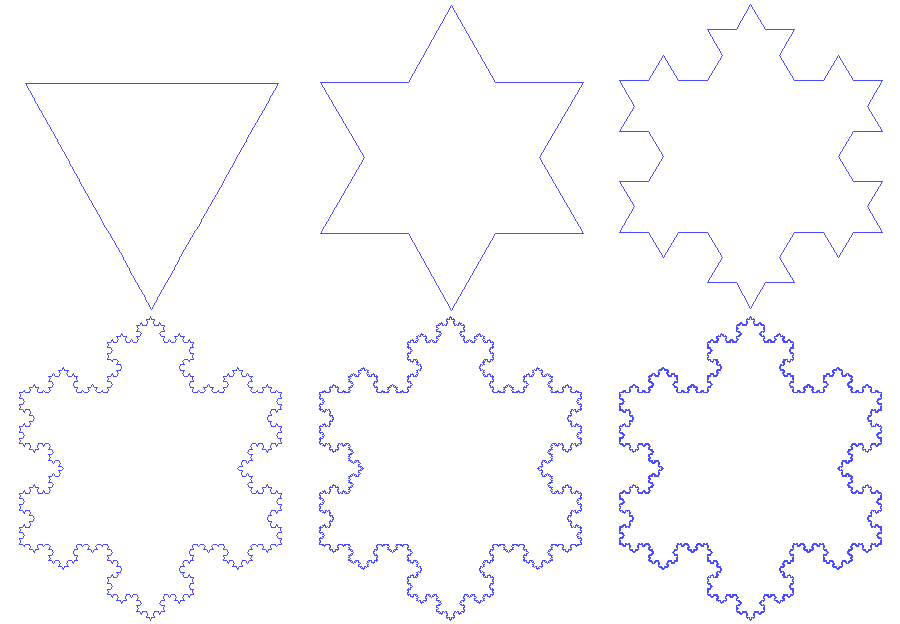
So, here's the lie of complexity. Mathematically,
The Koch curve has an infinite length because each time the steps above are performed on each line segment of the figure there are four times as many line segments, the length of each being one-third the length of the segments in the previous stage. Hence the total length increases by one third and thus the length at step n will be (4/3)n of the original triangle perimeter: the fractal dimension is log 4/log 3 ≈ 1.26, greater than the dimension of a line (1) but less than Peano's space-filling curve (2).But we can see intuitively from the animated .gif above that after the fourth iteration of the fractal, the area enclosed by the "infinite length" curve does not change, i.e., an infinite length bounds a finite space:
So the area of a Koch snowflake is 8/5 of the area of the original triangle, orThus, in spite of the beauty and certainty of mathematics, increasing the complexity of the fractal Koch curve to infinity does not change the fundamental, finite nature of what that curve actually describes..[2] Therefore the infinite perimeter of the Koch triangle encloses a finite area.
The Koch Star is no different than our current reality. You can divide labor as much as you want, to infinity even, but that will not change the fact that we live in a finite world. The complexity of the modern world is just as illusory as the infinite length of the Koch curve. Yes, in theory, if you keep on dividing things in two forever, you theoretically create perpetual exponential growth, but reality quickly intrudes by placing real limits on what can be achieved. Anybody who attempts to sell complexity beyond the limits of reality is, by definition, a liar and a fraud. Even if they don't realize it.
A separate but related thought I will develop is that Taoism (as set forth in the original Tao Te Ching) is not a spiritual or religious tract at all, but a timeless description of the seed function of the human societal fractal.


Sunday, June 26, 2011
Hoisted From My Own Comment Elsewhere: The Tyranny of the Middle-Man
I posted this comment over at Russ's place:
In the movie (but not the book) The Wizard of Oz, Dorothy was admonished to ignore the man behind the curtain. In modern economics, we're all implored to ignore the man between us and what we want.
And, sadly, we comply.
FYI -- I likely will have a burst of activity over the next week as I will be on vacation with my family. Be warned, though, I'm trying to find a way to work blogging into my daily life while not distracting from the many other things I want to accomplish. This inherently means that I'm going to be throwing a lot of seemingly half-formed things out there for consumption. Trust me, though, I don't throw out half-formed ideas, only half-formed expressions of them. Challenge me. Question me. I'll respond.
Comments have been acting up lately (Russ, Mr. Falberg and I have all had problems), so feel free to contact me directly at taojonesing@gmail.com
Fundamentally, I think you're arguing that liberty begins and ends with autonomy, which is inherently a local thing. No market can be a "free market" if it depends on the coordination of far-flung resources by a middle-man, as the middle-man will of necessity become the top-dog. All financialization ultimately boils down to creating a middle-man, an intermediary between market participants and what they seek to acquire. Whether the commodity in question is money or food, the middle-man can create gluts and shortages at will, and does so to further his own self-interest.An important point that economist Steve Keen has made about mainstream economics is that it models our economy as if there was no money, as if we were merely bartering. He makes this point most forcefully here, but you should consider a more undertaking a more complete treatment of the topic in his book, Debunking Economics, most of which you can find in a much more complete but less cogent form here.
In the movie (but not the book) The Wizard of Oz, Dorothy was admonished to ignore the man behind the curtain. In modern economics, we're all implored to ignore the man between us and what we want.
And, sadly, we comply.
FYI -- I likely will have a burst of activity over the next week as I will be on vacation with my family. Be warned, though, I'm trying to find a way to work blogging into my daily life while not distracting from the many other things I want to accomplish. This inherently means that I'm going to be throwing a lot of seemingly half-formed things out there for consumption. Trust me, though, I don't throw out half-formed ideas, only half-formed expressions of them. Challenge me. Question me. I'll respond.
Comments have been acting up lately (Russ, Mr. Falberg and I have all had problems), so feel free to contact me directly at taojonesing@gmail.com
"Efficiency" Is Tyranny; Scale Is Violence
These are a couple of thoughts that occurred to me as a result of my discussion with an economist friend on Tuesday.
My friend's premise, with which I disagreed, was that society prefers a small number of producers that make a particular good because that is the most efficient outcome. I argued that his conclusion assumed a definition of "efficiency" that simply did not have to be. If we were to define efficiency differently and construct a different set of rules to enforce that new definition (i.e., reconfigure the accounting rules, tax laws, etc. that enforce the current definition of efficiency), then the outcome could be different; i.e., society would prefer several small producers over one or two.
That didn't set well with him. He insisted that "this was physics," that economies of scale command industry consolidation into one or two firms.
I had to disagree again, and that's when the fun really began. Having worked at both monopolists (Intel) and startups, I know that most of the vaunted economies of scale arise from the fact that large firms demand-- and get-- much lower prices from their vendors. They likewise get much more favorable financing terms from banks and other financial institutions. Because large firms tend to have much lower input costs, they have a better cost structure than their competition, who falls farther and farther behind.
Desparate to make a point that could not be countered, he trotted out the division of labor and Adam Smith's pin factory, arguing that in many industries there is a minimum capital expense required just to get started, and that the widget maker who made a million widgets a year has a cost per widget that is a lot lower than a widget maker who uses the same size factory to make just one widget. Again, I disagreed, noting that it is accounting rules and tax laws regarding depreciation and amortization that drive his conclusion, not any law of nature.
So he called me irrational, at which point I took him a bit deeper into Adam Smith's body of work to identify a major weakness of modern economics, which is that it assumes that humans make economic decisions purely in monetary terms. Even Adam Smith recognized that was not the case, as his Invisible Hand was the manifestation of society's "moral sentiments," the set of rules that makes every citizen consider how his actions will be perceived by the rest of society. And behavioral economists, leveraging off of recent advances in cognitive science, have confirmed Smith's fundamental insights. As a result, I argued that modern economics is complete hogwash. The saying in corporate America is "if it can't be measured, it doesn't exist." and economists refuse to measure anything other than money.
I then turned his economies of scale argument on its head, noting that the returns to scale a large firm receives can be viewed as a tax on the rest of the industry. The vendor has its own success metrics, including profit margins that it will have to support by charging the large firm's competitors substantially more.
We quickly agreed to disagree and moved onto friendlier topics, but I have not been able to stop thinking about our conversation.
One thought is that efficiency, as currently understood, is tyranny. Economic efficiency is a prerequisite to maintaining the illusion of perpetual exponential growth. It is always and everywhere the enemy of competition and self-determination.
Another thought is that scale is violence, at least in economic terms. Too Big To Fail is a clear manifestation of this violence.
My friend's premise, with which I disagreed, was that society prefers a small number of producers that make a particular good because that is the most efficient outcome. I argued that his conclusion assumed a definition of "efficiency" that simply did not have to be. If we were to define efficiency differently and construct a different set of rules to enforce that new definition (i.e., reconfigure the accounting rules, tax laws, etc. that enforce the current definition of efficiency), then the outcome could be different; i.e., society would prefer several small producers over one or two.
That didn't set well with him. He insisted that "this was physics," that economies of scale command industry consolidation into one or two firms.
I had to disagree again, and that's when the fun really began. Having worked at both monopolists (Intel) and startups, I know that most of the vaunted economies of scale arise from the fact that large firms demand-- and get-- much lower prices from their vendors. They likewise get much more favorable financing terms from banks and other financial institutions. Because large firms tend to have much lower input costs, they have a better cost structure than their competition, who falls farther and farther behind.
Desparate to make a point that could not be countered, he trotted out the division of labor and Adam Smith's pin factory, arguing that in many industries there is a minimum capital expense required just to get started, and that the widget maker who made a million widgets a year has a cost per widget that is a lot lower than a widget maker who uses the same size factory to make just one widget. Again, I disagreed, noting that it is accounting rules and tax laws regarding depreciation and amortization that drive his conclusion, not any law of nature.
So he called me irrational, at which point I took him a bit deeper into Adam Smith's body of work to identify a major weakness of modern economics, which is that it assumes that humans make economic decisions purely in monetary terms. Even Adam Smith recognized that was not the case, as his Invisible Hand was the manifestation of society's "moral sentiments," the set of rules that makes every citizen consider how his actions will be perceived by the rest of society. And behavioral economists, leveraging off of recent advances in cognitive science, have confirmed Smith's fundamental insights. As a result, I argued that modern economics is complete hogwash. The saying in corporate America is "if it can't be measured, it doesn't exist." and economists refuse to measure anything other than money.
I then turned his economies of scale argument on its head, noting that the returns to scale a large firm receives can be viewed as a tax on the rest of the industry. The vendor has its own success metrics, including profit margins that it will have to support by charging the large firm's competitors substantially more.
We quickly agreed to disagree and moved onto friendlier topics, but I have not been able to stop thinking about our conversation.
One thought is that efficiency, as currently understood, is tyranny. Economic efficiency is a prerequisite to maintaining the illusion of perpetual exponential growth. It is always and everywhere the enemy of competition and self-determination.
Another thought is that scale is violence, at least in economic terms. Too Big To Fail is a clear manifestation of this violence.
Monday, June 20, 2011
I'm Done With Mainstream Econo-Blogs
Naked Capitalism is the last mainstrream econoblog that I still frequent, and I've decided that continuing to visit the site is of little value to me.
It's bad enough that Yves has elected to give "air time" to the smug, self-celebrating Philip "I'm so fucking smart" Pilkington, a guy who pimps MMT in a way to make it sound hopelessly naive.
But the real problem is tha lack of any effort to define solutions to the problems that are now so very clear. The aim of the blog appears merely to be to confirm, yet again, that people like "us" were right to say there's a problem because, well, there's a problem! Mirable dictu!
Quelle surpise? Not really. You make money by exercising people's concerns, not by resolving them.
Why quit frequenting NC now? I have found that all I care about are comments from attempter and DownSouth. Everybody else is too stuck within the current paradigm to say anything of interest. Like me, however, attempter and DownSouth don't comment nearly as much as they once did.
It's bad enough that Yves has elected to give "air time" to the smug, self-celebrating Philip "I'm so fucking smart" Pilkington, a guy who pimps MMT in a way to make it sound hopelessly naive.
But the real problem is tha lack of any effort to define solutions to the problems that are now so very clear. The aim of the blog appears merely to be to confirm, yet again, that people like "us" were right to say there's a problem because, well, there's a problem! Mirable dictu!
Quelle surpise? Not really. You make money by exercising people's concerns, not by resolving them.
Why quit frequenting NC now? I have found that all I care about are comments from attempter and DownSouth. Everybody else is too stuck within the current paradigm to say anything of interest. Like me, however, attempter and DownSouth don't comment nearly as much as they once did.
Monday, June 13, 2011
Harriet Beecher Stowe
I just took a quick glance at this story over at Salon.com regarding a review of a recent book about Harriet Beecher Stowe. I think the history described by the author is, well, a bit wrong.
Generally, and let's be clear about this, slavery was indeed one of the twin pillars that formed the foundation (you like mixed metaphors, well there you go) of the U.S. Constitution. That does not mean that there was any sort of agreement about slavery other than the fact that the mercantilist Northern elite agreed to allowing slavery to persist in exchange for the physiocratic Southern elite's agreement to accept tariffs. Go back and read the Constitution (without the Bill of Rights, which was added later) and the compromise between tariffs and slavery is starkly obvious. Indeed, in the run up to the Civil War, there was a book that made precisely this point.
What I find disturbing about the laudatory praise of Ms. Stowe is the notion that she was somehow "liberal" for her age. The fact is that many Northern states had abolished slavery within their borders before ever entering into the Constitution, an argument that was made by Dred Scott's lawyers to the Supreme Court.
When you look at the historical pressures that led up to the Civil War, what you see is the fact that the Southern states were using the Constitution as a club to force Northern states to support and perpetuate the institution of slavery. Abolitionism wasn't really an attempt to do away with slavery as much as it was an attempt to hold the line on slavery in the Northern states. The abolitionist movement would never have arisen but for the fact that Southern states were constantly seeking to force Northern states to support slavery through fugitive slave laws, etc. Indeed, the first proposed "papers please law" required freed slaves to carry papers with them to prove they were not fugitive slaves. The failure to have such papers would have allowed fugitive slave hunters to kidnap free black men and women and "extradite" them to the Southern states, which they apparently did quite often.
Bottom line: the smaller Southern states had succeeded for decades in browbeating the larger Northern states into accepting and expanding the institution of slavery much more broadly than contemplated by the Constitution. In this sense, the Civil War was really a war of aggression by the slaveholding Southern states: the abolitionist movement arose as a bulwark against extra-constitutional encroachment of slavery into the Northern states, something that the Dred Scott decision all but assured. The Southern states could not abide a reversal of their fortune.
Against this backdrop, I have a real problem with the concept of portraying Ms. Stowe as some kind of "liberal" hero that the current "progressive" movement can take lessons from. She was merely a representative of one of the dominant forces in the United States. Yes, she was a particularly effective propagandist-- and I say this as somebody who enjoyed her book and agreed with her message-- but to lionize her as some kind of hero is to confuse the effectiveness of her presentation with her real aims. Like the "pro-life" advocates of the present era, she did not care about or take responsibility for ensuring the quality of life of those she claimed to represent and protect. She was far more interested in limiting the options available to her opponents than she was to helping the pawn she used to achieve that end.
And I say all this as somebody who believes that Harriet Beecher Stowe actually performed a real service to our country.
Generally, and let's be clear about this, slavery was indeed one of the twin pillars that formed the foundation (you like mixed metaphors, well there you go) of the U.S. Constitution. That does not mean that there was any sort of agreement about slavery other than the fact that the mercantilist Northern elite agreed to allowing slavery to persist in exchange for the physiocratic Southern elite's agreement to accept tariffs. Go back and read the Constitution (without the Bill of Rights, which was added later) and the compromise between tariffs and slavery is starkly obvious. Indeed, in the run up to the Civil War, there was a book that made precisely this point.
What I find disturbing about the laudatory praise of Ms. Stowe is the notion that she was somehow "liberal" for her age. The fact is that many Northern states had abolished slavery within their borders before ever entering into the Constitution, an argument that was made by Dred Scott's lawyers to the Supreme Court.
When you look at the historical pressures that led up to the Civil War, what you see is the fact that the Southern states were using the Constitution as a club to force Northern states to support and perpetuate the institution of slavery. Abolitionism wasn't really an attempt to do away with slavery as much as it was an attempt to hold the line on slavery in the Northern states. The abolitionist movement would never have arisen but for the fact that Southern states were constantly seeking to force Northern states to support slavery through fugitive slave laws, etc. Indeed, the first proposed "papers please law" required freed slaves to carry papers with them to prove they were not fugitive slaves. The failure to have such papers would have allowed fugitive slave hunters to kidnap free black men and women and "extradite" them to the Southern states, which they apparently did quite often.
Bottom line: the smaller Southern states had succeeded for decades in browbeating the larger Northern states into accepting and expanding the institution of slavery much more broadly than contemplated by the Constitution. In this sense, the Civil War was really a war of aggression by the slaveholding Southern states: the abolitionist movement arose as a bulwark against extra-constitutional encroachment of slavery into the Northern states, something that the Dred Scott decision all but assured. The Southern states could not abide a reversal of their fortune.
Against this backdrop, I have a real problem with the concept of portraying Ms. Stowe as some kind of "liberal" hero that the current "progressive" movement can take lessons from. She was merely a representative of one of the dominant forces in the United States. Yes, she was a particularly effective propagandist-- and I say this as somebody who enjoyed her book and agreed with her message-- but to lionize her as some kind of hero is to confuse the effectiveness of her presentation with her real aims. Like the "pro-life" advocates of the present era, she did not care about or take responsibility for ensuring the quality of life of those she claimed to represent and protect. She was far more interested in limiting the options available to her opponents than she was to helping the pawn she used to achieve that end.
And I say all this as somebody who believes that Harriet Beecher Stowe actually performed a real service to our country.
Responding to the most recent comment
Blogger is puking on my attempt to provide a comment, so I'm responding to Mr. Falberg here.
I prefer to not resort to ideas like the "New World Order."
First, to the extent that a New World Order is actually contemplated, it is merely a new new New World Order (at least) meant to secure power in light of society evolving to a point where it wants to take that power away.
Second, the current NWO theory infuses far too much lifelike detail into what is at best a thumbnail sketch. Indeed, the ruling elite would be stupid to insist on a "one world government" because a key aspect of maintaining control without responsibility is to be behind the scenes and out of sight. The more people there between you and the audience, the less likely they'll be able to see you. The current system is already far more effective than a one world government would ever be.
And the worst part about it is that a lot of the people who believe in and push the NWO thesis love them thelr natural law, their John Locke, and their Thomas Jefferson, i.e., they just prefer the old NWO over the one they see coming.
I care less about the conspiracies and more about the mechanisms that allow us to be duped by them. The only thing we can control is our own actions. I can't stop somebody from trying to dupe me, but I don't have to allow myself to be duped. The problem with the NWO theory is that it assumes its starting worldview is itself valid and true when, in fact, it appears to be just a prior version of the NWO, at least to me.
I prefer to not resort to ideas like the "New World Order."
First, to the extent that a New World Order is actually contemplated, it is merely a new new New World Order (at least) meant to secure power in light of society evolving to a point where it wants to take that power away.
Second, the current NWO theory infuses far too much lifelike detail into what is at best a thumbnail sketch. Indeed, the ruling elite would be stupid to insist on a "one world government" because a key aspect of maintaining control without responsibility is to be behind the scenes and out of sight. The more people there between you and the audience, the less likely they'll be able to see you. The current system is already far more effective than a one world government would ever be.
And the worst part about it is that a lot of the people who believe in and push the NWO thesis love them thelr natural law, their John Locke, and their Thomas Jefferson, i.e., they just prefer the old NWO over the one they see coming.
I care less about the conspiracies and more about the mechanisms that allow us to be duped by them. The only thing we can control is our own actions. I can't stop somebody from trying to dupe me, but I don't have to allow myself to be duped. The problem with the NWO theory is that it assumes its starting worldview is itself valid and true when, in fact, it appears to be just a prior version of the NWO, at least to me.
Subscribe to:
Posts (Atom)